|

|

|
No
postcard or photographic image currently in my collection for this
location.*

The Government of the Hashemite Kingdom of Jordan, whose land is the
seedbed of many civilizations and religions, is represented by one of
the most striking buildings at the Fair. It is a
multi-peaked-and-domed structure covered with gold mosaic and sparkling
colored glass. The undulating roof surfaces swoop to the
ground,
forming Arabic arches: They shade the stained-glass windows
that
make up two sides of the building and walls with bas-reliefs that make
up the other sides. Inside the building diverse exhibits -
including a scroll from the Dead Sea area - reflect some of the
cultures that rose in this region of ancient Palestine. A
theater
provides entertainment by Arab dancers and a military band.
Admission:
adults 50 cents. children free.
Christ and Mohammed. In
stained glass (best seen from inside the pavilion), the story of
Christ's agony and death is told in the traditional Fourteen Stations
of the Cross, rendered in unusual abstract forms created by Spanish
painter Antonio Saura. On the other walls (seen only from outside
the pavilion) are bas-relief representations of the Roman-built city of
Jerash; the ancient city of Petra, which was carved from rock in
ancient times and populated by robber bands that preyed on caravans;
and the Dome of the Rock of Jerusalem, where, according to Muslim
tradition, Mohammed prayed before ascending to heaven.
Twenty
Hundred Years. One
of the Dead Sea Scrolls, written by the ascetic Essene about the time
of Christ, is shown in an exhibit area together with a replica of the
cave in which it was discovered. Also on display are a scale
model of the Dome of the Rock, statues of the Three Kings, a Christian
crèche, and many articles from antiquity, including a column from
Jerash to be presented to the City of New York for permanent display in
the Flushing Meadow park.
Dancers
and a Movie. A
troupe of Arab dancers and a military band of pipers put on frequent
performances in the 245-seat theater. At other times a
half-hour
color movie of modern Jordan is shown.
Jewelry
and Barbecues. Large
color transparencies and slide viewers show Jordan's expanding economy
and increasing numbers of schools, hospitals, roads, and other
facilities. A bazaar sells Hebron glass, olive-wood carvings,
mother-of-pearl work and Bedouin jewelry. A restaurant and
snack
bar serve such Jordanian specialties as hummas (an appetizer of mashed
chickpeas mixed with spices and oil, eaten cold), shawarmah (spiced and
barbecued lamb), Arab and Turkish pastries, coffee and wine.**

The
Jordan pavilion, with it's unusual design, attracted many who were
interested in the historical and religious relics on display there.
It
was not without controversy, however, as a mural at the pavilion's exit
caused a commotion with the nearby Israeal pavilion. The mural, which
depicted a refugee and her child, was accompanied by a poem by an
unknown author. The poem, which began with the words "Before
you
go, have you a minute more to spare to hear a word on Palestine and
perhaps to help us right a wrong?", started a rather public
disagreement between the American-Israel pavilion and the Jordan
pavlion which plagued both for the duration of the Fair.
The
American-Israel pavilion accused the Jordan pavilion of turning the
Fair into a "battleground" of sorts, using their pavilion to spread
anti-Isreal propoganda. A legal battle ensued, with the City
Council finally issuing a verdict that the offensive mural was to be
removed... but without a set timeline to do so. The mural
remained up until the closure of the Fair in late 1965.

The
pavilion, itself, was never designated as a permanent addition to the
park, so it was dismantled at the close of the Fair. The
antiquities and religious relics which were displayed within the
pavilion were returned and either displayed or stored for their
protection.
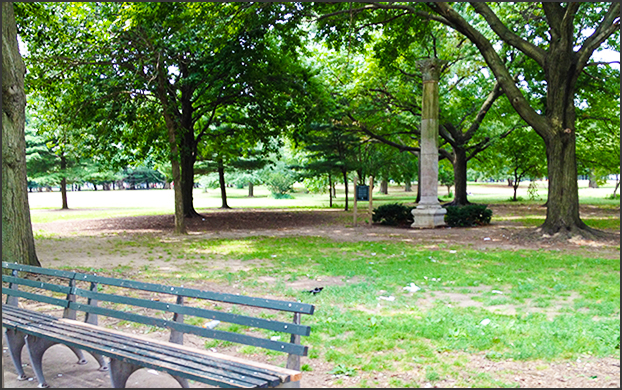
During the Fair, the "Whispering Column of Jerash"
stood proudly on a clear piece of land next to the Jordan pavilion.
Intended to be a permanent addition to the park at the end of the Fair,
it would remain on-site after the close of the 1965 season.
It is
the second-oldest outdoor antiquity in New York... second only to
Cleopatra's Needle in Central Park.

IDuring
one of my visits to the site of the New York World's Fair 1964/1965, I
visited the "Whispering Column of Jerash", which was installed there as
part of the Jordan pavilion. It currently stands on the exact
spot it was originally installed and is the second-oldest outdoor
antiquity in New York.
After
taking the 7 train from Manhattan to Queens, I strolled through the
park. It was a beautiful day and the park was alive with
activity. There were tons of people using the soccer and
volleyball fields or just taking a leisurely stroll through the same
streets which carried many thousands of visitors to the World's Fair.
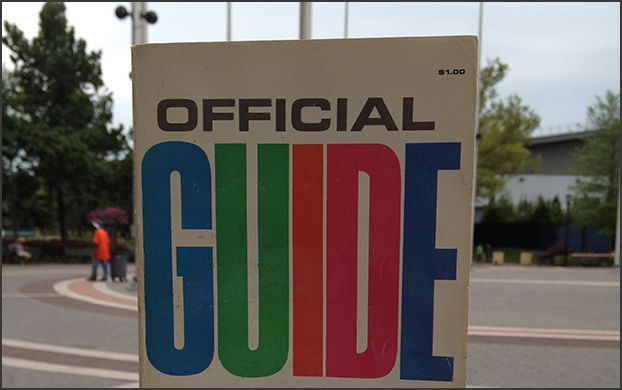
I pulled out my official guide to the Fair and began navigating to the
site of the Jordan pavilion.
|
|
 |
 |
|
The
site of the pavilion is now a beautiful, shady place to rest and
reflect. Park benches nearby provide the perfect spot to sit
down
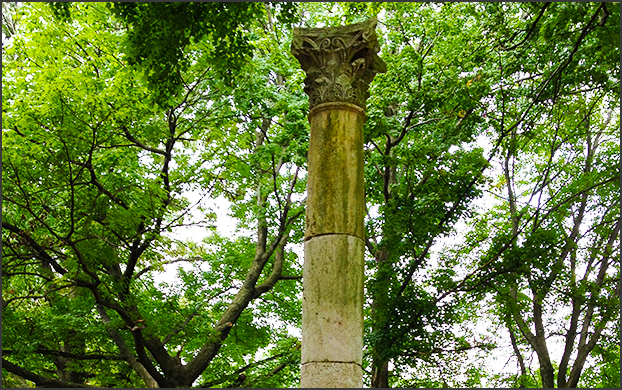
and read. The Whispering Column of Jerash sits back from the
path
and almost blends in with the surrounding trees... so it's easy to see
why some park visitors may not even know this historical antiquity
exists here.
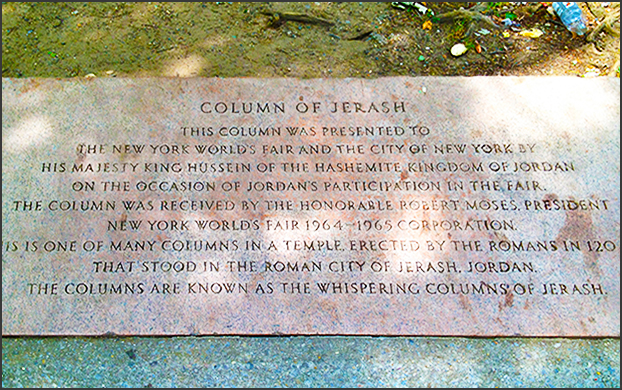
An engraved marker lies beside the path so you may learn about the
column without walking up to it...
|
"This
column was presented to the New York World's Fair and the City of New
York by His Majesty King Hussein of the Hashamite Kingdom of Jordan on
the occasion of Jordan's participation in the Fair. The
column
was received by the honorable Robert Moses, President, New York World's
Fair 1964-1965 Corporation. This is one of many columns in a
temple erected by the Romans in 120 AD that stood in the Roman city of
Jerash, Jordan. The columns are known as The
Whispering
Columns of Jerash."
|
|
 |
 |
|
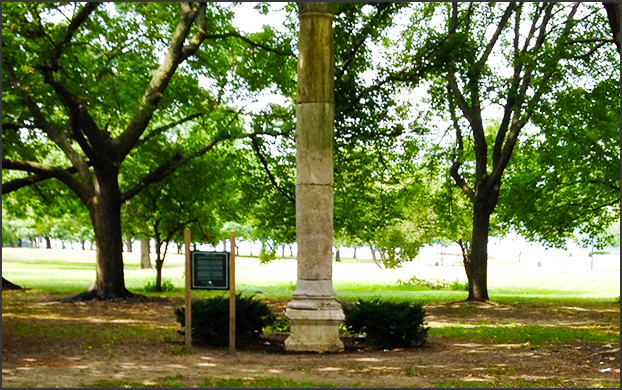
I
decided to get up close and personal with the column, not just to
appreciate its historical value and observe the amazing detail in its
cornice, but also to read the sign placed next to it by the New York
Parks Department.
During the Fair, the Whispering Column of
Jerash stood sentinel in a clear space next to the Jordan pavilion.
It is still standing on that same spot today... though now it
is
surrounded by bushes and trees. |
As
I had previously seen two different ways to spell Jarash/Jerash, I
pulled out my phone and looked up which was actually correct.
The
official guide refers to the city of "Jarash", while the signage and
markers in the park today refer to "Jerash". It appears that
the
spelling of the ancient Roman city is actually Jerash... not to be
confused with Jerash, which is a Palenstinian village in Jerusalem.
The
official guide also had a few other spelling issues... like "Moslim",
"Homas", and "Chick Peas". I ended up correcting them for
this
page. |
|
 |
 |
|
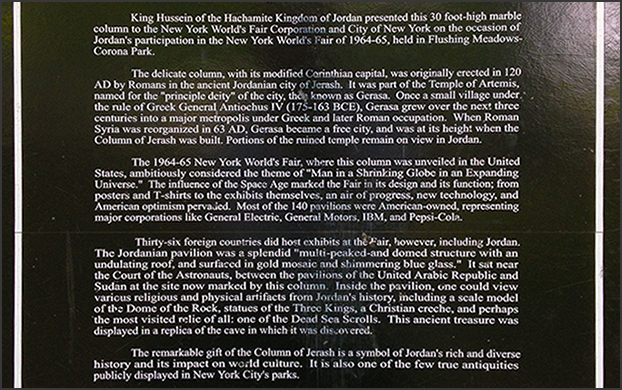
The
small sign next to the column is a history lesson about the column.
"This delicate column, with its modified Corinthian capital, was
originally erected in 120 AD by Romans int he ancient Jordanian city of
Jerash. it was part of the Temple of Artemis, named for the
"principle deity" of the city, then known as Gerasa."
It goes on
to mention how the "remarkable gift of the Column of Jerash is a symbol
of Jordan's rich and diverse history and its impact on world culture.
It is also one of the few true antiquities displayed in New
York
City's parks." |
|
After spending some time with the Whisphering Column of Jerash and
enjoying the park, it was time for me to head back out. I
enjoyed
my visit to this amazing relic of the New York World's Fair... and hope
you have, too! |
|
 |
 The
Whispering Column of Jerash is a publicly-available antiquity and
requires little maintenance. The surrounding area tends to be
littered with empty water bottles and picnic trash... so if you ever
plan to visit, it would be nice if you brought a small plastic bag with
you and volunteered to tidy up the area a bit. Nearby trash
cans
would be an easy place for you to deposit the trash you have collected. The
Whispering Column of Jerash is a publicly-available antiquity and
requires little maintenance. The surrounding area tends to be
littered with empty water bottles and picnic trash... so if you ever
plan to visit, it would be nice if you brought a small plastic bag with
you and volunteered to tidy up the area a bit. Nearby trash
cans
would be an easy place for you to deposit the trash you have collected.
As this
relic of the World's Fair is currently maintained by
the New York City Parks Department and is well preserved, no assistance
is currently required. You can,
however, let the New York City Parks Department know how much you
appreciate the work they are doing to keep this World's Fair relic in
great shape.
You may also send a note of encouragement to the President of
the
Borough of Queens via their website.
Giving Thanks.
The
following individuals contributed towards making it possible for me to
visit and document this remnant of the 1964/1965 New York World's Fair.
I'd like to take a moment to personally thank them for
helping
make my dream of personally visiting the remaining pavilions of the
World's Fair come true.
John DePalma
Nicole Desmond
Joseph Desmond
Susan Tackett
This page is hereby dedicated to them.
*Pavilion Image - Do you have a postcard or a clean scan of a slide of
the exterior of this Pavilion? Contact me!
**Official Guidebook Information - Official
Guide New York World's Fair 1964/1965 (c.1964 Time Inc.).
**Corrected based on currently-accepted spellings of "Jerash",
"Muslim", "hummas", "shawarma", and "chickpeas".
|
|
|
|