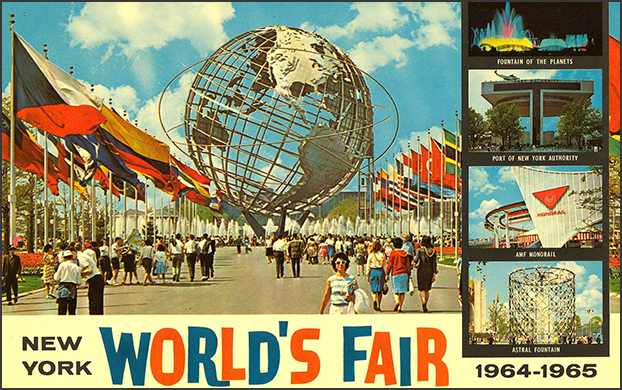
Postcard
of the UnisphereŽ, published by Dexter Press*
Symbol of the New York World's Fair 1964/1965 is this 12-story
stainless steel model of the earth designed, built, and presented by
United States Steel. Dedicated to "Peace Through
Understanding," the Unisphere will remain on its site when the Fair is
over, as a permanent gift to the City of New York for the improved
Flushing Meadow Park that will be created on the fairgrounds.
It is located at the Fountain of the Continents, near the
center of the Fair. Seen from the edge of the pool, it shows
the world as it appears from 6,000 miles in space.
Highlights
The Statistics. The
Unisphere is the largest representation of the earth man has ever made.
It is 140 feet high and 12 feet in diameter, and - with its
tripod-like base - weighs 900,000 pounds. The spehere is
formed of an open grid of meridians and parallels. Laid on
them are curved sheets of stainless steel representing the land masses;
the capitals of majors nations are marked by lights.
The
Design. Unprecendented
problems had to be solved in constructing the huge model.
Because the continents are not evenly distributed on earth,
the Unisphere, which stands on three slender prongs, in an unbalanced
ball. Furthermore, the metal land-mass areas act as sails in
the wind, building up enormous and unequal pressures against the curved
surfaces. The structure required the solution of mathematical
problems so complex that without high-speed computers planning the
Unisphere would have taken 10 years.** United States Steel was given the
task of designing and constructing the theme symbol of the New York
World's Fiar 1964/1965. To quote Robert Moses, who oversaw
the World's Fair as its President, "What stronger, more durable, and
more appropriate metal could be thought of than stainless steel?
And what builder more imaginative and competent than U.S.
Steel?"
United States Steel's assignment wasn't an easy one. Nothing
like this had ever been attempted before. Design the world's
largest representation of the Earth, but do it in a way which suggested
lightness and grace. The result would require the use of the
most powerful computers on the planet to figure out thousands of
calculations. More than 500 individual structural elements
were designed and assembled on-site in Queens like a giant
three-dimensional jigsaw puzzle.
At night, a unique lighting setup demonstrated the transition of day to
night as the light of the sun travelled across the continents around
the globe. Special lights, embedded in the continents, marked
the capitals of major countries. Fountains around the base of
the Unisphere added a fantastic kinetic element to the Fountain of the
Continents. At the conclusion of
The Fair, the Unisphere remained on-site and available for
visitors' enjoyment at the heart of the newly restored Flushing Meadows
Corona Park.
Over the decades following the fair, the Unisphere fell into slight
disrepair as funds to maintain the park dwindled in the late 1970s. It
was refurbished when the economy regained its strength and has been
beautifully maintained ever since by the New York City Parks Department.
The fountains surrounding the Unisphere in the Fountain of the
Continents have been refurbished and now run almost daily during warmer
months for the public's enjoyment. Benches nearby provide the
perfect, shaded place to sit and reflect, read, or people watch.
The nighttime lighting package, with its day-to-night
transition and lights to denote country capitals, did not remain after
the Fair ended. Today, the Unisphere is simply awash with
bright white light at night. Flushing
Meadows Corona Park is a beautiful public space full of easy World's
Fair finds for the amateur urban archaeologist. In addition
to a few lesser-known (and somewhat hidden) relics in the park, several
pavilions still remain on-site...some of which still operate
daily. The Unisphere is at the heart of the park, accessible
from all major pathways.
My
first visit to the park was
in March of 2015, when I was given an unexpected opportunity to travel
to New Jersey and New York. The trip took place just before
Disney's Tomorrowland was released in
movie theaters. As a New York World's Fair fan, I was excited
by
the scenes in the previews, which showed that the Fair would play a
rather important part in the film's
storyline. Having never been to the actual site of the Fair
and
being so close, I wanted to take the opportunity to visit Flushing
Meadows Corona Park. Needless to say, I immediately fell in
love.
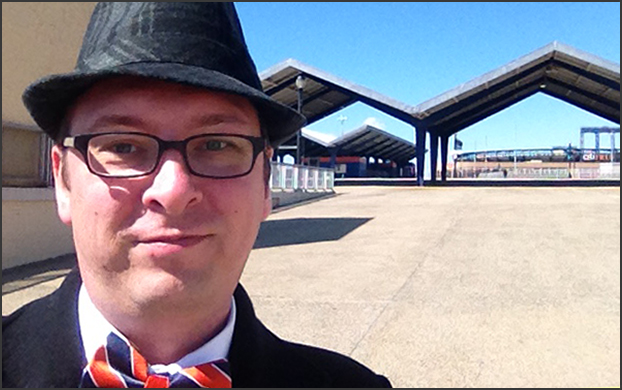
Arriving
at Willets Point station via the 7 train, we walked down the boardwalk
to the park entrance. As the zig-zag roofline of the park
entrance came into view, excitement welled up inside me.
Beyond that roof, a world of wonder awaited lucky visitors to the
1964/1965 New York World's Fair... and I was about to get to walk in
their footsteps. As I walked down the long ramp of the
Passerelle, I snapped a photo to prove to myself that it wasn't all
just a dream later on.
According
to my official Guidemap from the New York World's Fair, all of the
pathways before us would eventually provide us with an amazing view of
the Unisphere, but we wanted to get up close and personal with the
theme structure, itself.
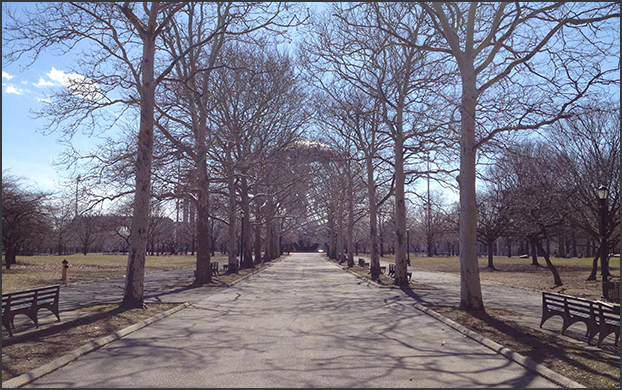
We made a slight right at the bottom of the Passerelle and walked down
the Avenue of the Americas toward the Fountain of the Continents.
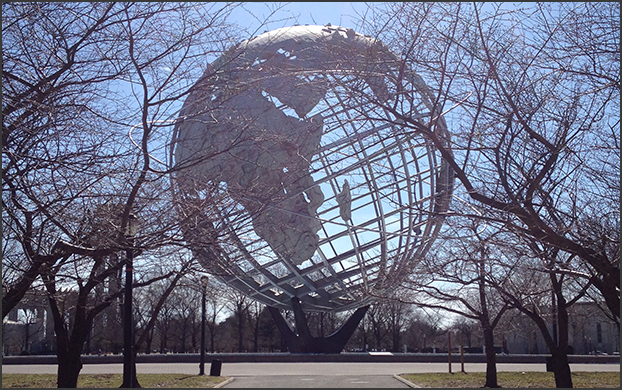
With it being the tail-end of winter, the trees were bare,
giving us an exciting preview of things to come through the branches.
As we
reached the end of the avenue the trees began to pull away, like the
curtain at a theater, to reveal the Unisphere standing at the heart of
the park in all its glory! To the left, you could see the New
York State pavilion. To the right, you could see the City of
New York pavilion.
It was everything I could do to slow my pace and take in every moment
of the "grand reveal" happening before my eyes. As a fan of
unique architecture, this experience was akin to meeting a celebrity
and having a "fanboy" moment.
We
approached the edge of the Fountain of the Continents and saw the
massive fountain nozzles. We walked around the perimeter,
taking in the topographical details of the various continents.
We imagined
what it must have been like for this area to be filled with visitors on
their way to the many fascinating adventures which awaited them during
the Fair. What it must have looked like with the pool filled
and fountains going.
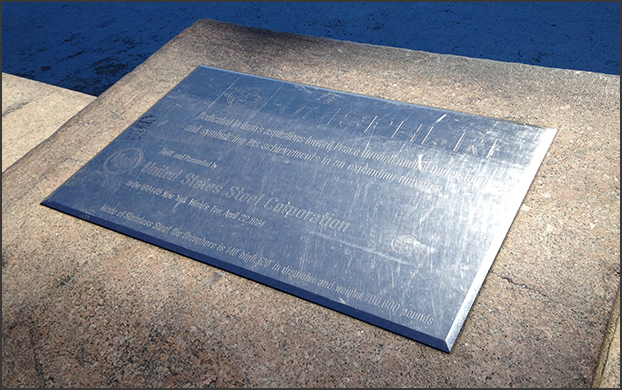
While we
walked around the empty pool, we came across a dedication plaque for
the Unisphere. It read: "UNISPHERE Dedicated to man's
aspirations towards peace through understanding and symbolizing his
achievements in an expanding universe. Built and presented by United
States Steel Corporation to the 1964-65 New York World's Fair, April
22, 1964. Made of Stainless Steel, the Unisphere is 140'
high, 120' in diameter, and weighs 700,000 pounds."
I'm guessing the additional 200,000 pounds mentioned in the Official
Guidebook represents the tripod base.
Normally, I
wouldn't condone jumping into a fountain and walking right up to the
centerpiece, but after watching another parkgoer do it and in the
absence of signs telling us we weren't allowed to, I stepped over the
wall and walked to the center of the empty pool to the tripod base.
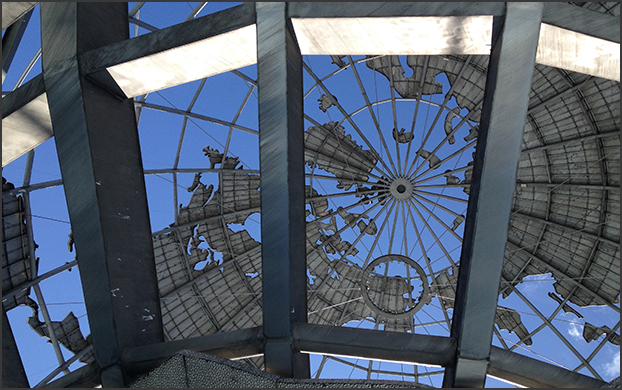
I looked up in awe of the Unisphere, noting some of the more structural
elements like the tension ring in the center of the globe.
From it radiated stainless steel cables meant to help the
globe keep its form against the downward pull of gravity.
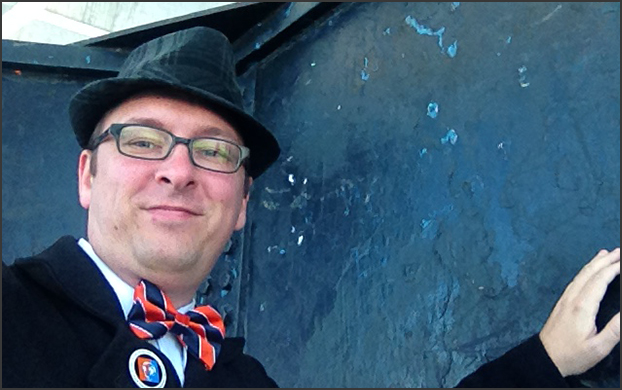
I'm also
normally a "hands in pockets" sort of guy. I don't walk up to
relics in a museum and just start touching them. For one,
that would probably get me thrown out or arrested. But,
again, in the absence of any signage to tell us we couldn't, I just had
to touch the Unisphere and prove to myself that I was really, really there.
The base of the Unisphere provided a temporary shelter from the icy
cold winds which had picked up. I could tell our time in the
park would be limited by the cold, so we began to make our way towards
our next destination.
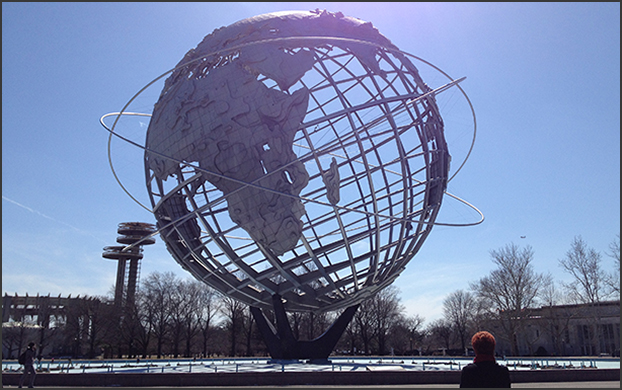
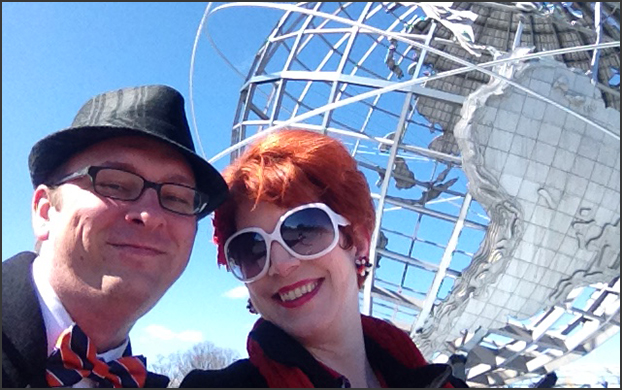
As my
friends and I stepped away from the Unisphere and out of the Fountain
of Continents, we took the opportunity to snap this beautiful photo of
ourselves with the Unisphere.
With the practically cloudless, sunny sky... and with us dressed in our
World's Fair finest attire, we just couldn't pass up the opportunity to
take that "once in a lifetime" souvenir photo of ourselves with this
amazing structure.
It turned out great, don't you think? You'd never know either
of us were freezing our butts off!
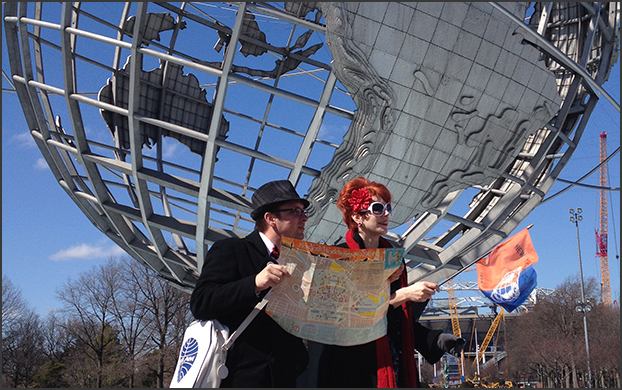
I pulled
out my official Guidemap of the New York World's Fair 1964/1965 to find
the route to our next destinations, the New York State pavilion, the
site of "it's a small world" and "Carousel of Progress"...and we were
on our way!
As the sun began to set in the West and the temperatures began to drop
even more, we gathered ourselves together, exited the park via the
Passerelle, and called for a car to meet us across the street at the
CitiField parking lot.
I was all smiles for the rest of the evening.
I would
return to the park several times after this visit (all in much warmer
weather), so I could see the park in all its natural beauty as well as
see the Fountain of the Continents in action. I have also
taken the
time to visit and document some of the other World's Fair structures
and attractions still available to visitors on-site.
Access to the park is free, and any World's Fair fan should definitely
add a visit to Flushing Meadows Corona Park to their list of things to
do while in New York!
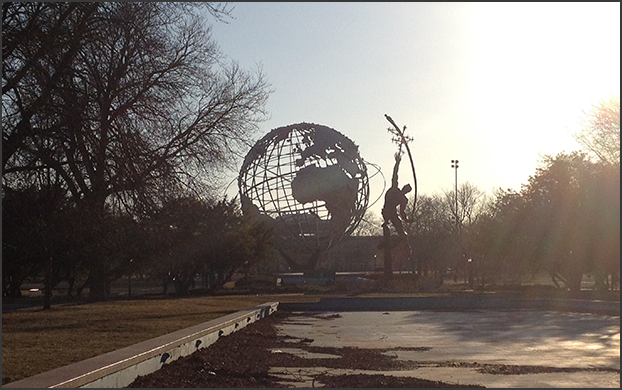
Enjoy
this
"window on the world" I took during a later visit to Flushing Meadows.
It was while the U.S. Open was taking place at the Tennis
Center (which is also on-site). As you can see, the park is
still
very much a gathering place for the community...and that the Unisphere
is still playing an important part of the park. In the
background, you see the towers of the New York State pavilion peeking
out above the tree line.
This relic
of the World's Fair is well preserved and is regularly maintained for
the enjoyment of all by the New York City Parks Department.
As this relic of the World's Fair is currently maintained by
the New York City Parks Department and is well preserved, no assistance
is currently required. You can,
however, let the New York City Parks Department know how much you
appreciate the work they are doing to keep this World's Fair relic in
great shape.
You may also send a note of encouragement to the President of
the
Borough of Queens via their website.
Remember...These wonderful experiences from the New York World's Fair
are still around today thanks to the support of certain individuals or
organizations. While visiting these relics from The Fair, be
sure to ask how you get involved to help ensure they remain part of our
world! You might just be able to become an important part of
the legacy of the New York World's Fair, too!
Giving Thanks.
The
following individuals contributed towards making it possible for me to
visit and document this remnant of the 1964/1965 New York World's Fair.
I'd like to take a moment to personally thank them for
helping
make my dream of personally visiting the remaining pavilions of the
World's Fair come true.
John DePalma
Nicole Desmond
Joseph Desmond
Susan Tackett
This page is hereby dedicated to them.
*Postcard Image - Scanned from the personal collection of Jason "Tiki"
Tackett.
**Official Guidebook Information - Official
Guide New York World's Fair 1964/1965 (c.1964 Time Inc.)
TIKITACKETT.INFO/WORLDSFAIR
is an unofficial New York World's Fair 1964/65 fan site and is in no
way affiliated with any single organization or group representing the
Fair's legacy.
Some parts of this website may feature Copyrighted
material which belongs to others. In these cases, appropriate
recognition is given whenever possible. No
parts of this site are to be reproduced without permission.
Peace Through Understanding MADE IN THE U.S.A.